Blog


First Light

A few posts back I wrote about how I wanted to paint a larger version of scene I had done while I was in Canyon de Chelly.  It was a fairly hilarious scene.  We got there when it was still pitch black and it was quite the comedy to see us trying to set up our tripods and pochade boxes in a hurry to get set up before the sun came up.

I don't know what I expected, but it was pretty hard to get anything down that resembled a sunrise.  I did a little 8x6 just to put some notes down before the sun was high in the sky.  I definitely need to practice more nocturnes as well as sunrises and sunsets. 

Painting at dawn

Since I'd had several disappointing efforts making paintings with dark foregrounds, I had decided to do a small study of a dawn painting before creating a larger version.  I wrote about it in a earlier post which I called "DAWN".

I was very happy with my little 8x8 study called "Dawn". 

I shared the post on Facebook and several of my friends reminded me that making a larger painting is entirely different than painting a small one.  Brushwork isn't the same... scale is different... nothing is really the same.

That's one of the reasons it took me a bit of time to even begin the larger painting.  - I was afraid I couldn't.  But I finally realized that it wasn't supposed to be the SAME painting.  I wanted to paint the dawn over the canyon.  I had created a nice practice painting.  I had learned by doing the smaller painter. 

So I started playing with color and paint and had a great time.  It may not be totally finished....  I'll let it sit for a while to "rest".

I hope you like my larger painting "First Light".

Read Full Post


Surfing At Mondos

Tyler went surfing at Mondos.  He had a blast!
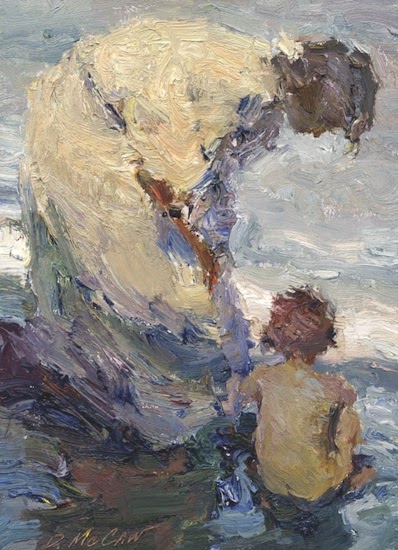
While he surfed, I painted a few of the kids on the beach in front of me.
It was a fun day.


INFLUENCES

 
There is an exhibition of some of the body of work of Joaquin Sorolla, who has long been among my favorite artists.  I never learned about him in school.  Frankly my art education was rather dismal.  I learned of Sorolla's work after I began taking classes from John Paul Thornton at Mission Renaissance about 12 years ago.  John Paul taught me the basics -- drawing, values, and oil and helped me learn to love painting and art history.  I owe him an immense debt of gratitude.

If possible, I plan to go several times to see this wonderful exhibit down in San Diego.  Sorolla's work is an inspiration to me.   Joaquin Sorolla's work is masterful in catching light and color and freshness.  It is joyful, enriching and influential.


Children On The Beach   1917


Sorolla and America

Now through August 26, 2014

The story of Sorolla and America begins in 1893, with Joaquín Sorolla y Bastida's prize-winning submission to the World’s Columbian Exhibition in Chicago.


                                                                                                             Sewing The Sail  1896

Many of my favorite artists were influenced by Sorolla and I have been too.  Those that immediately come to mind are John Asaro and Dan McCaw's early work.  Here are some examples:

   On the left is "Watchful Eye" by Dan McCaw


   On the right is "Sisters" by John Asaro

Both of these artists have moved on and are exploring somewhat different styles, but it is clear that Sorolla's work tremendously influenced both artists.

And I am hoping all three will influence me.  I know I was thinking of their work as I did my plein air sketch at Mondos.  I was there watching Tyler on his first attempt at surfing.  He did a GREAT job.  I am hoping to go back and paint at the beach again... always with the beautiful work of Sorolla in my mind and heart.

I enjoyed painting Tyler and his friends at the beach a while back.  (It was called "Boys At The Beach" )   Perhaps after I've done several plein air sketches like this one and the other one, I'll try a studio piece with Asaro, McCaw and Sorolla as my muses.


"Surfing At Mondos"

Read Full Post


Dawn

Dawn at Tsegi Overlook in Canyon de Chelly.


I had decided that I might want to paint the dawn over Tsegi Overlook in a larger format studio painting.   First, however, I thought I'd better work out some of the issues by doing a smaller piece.  As I mentioned in my last post, I often have trouble dealing with the low values and close differences in value inherent in sunsets and dawn foregrounds.


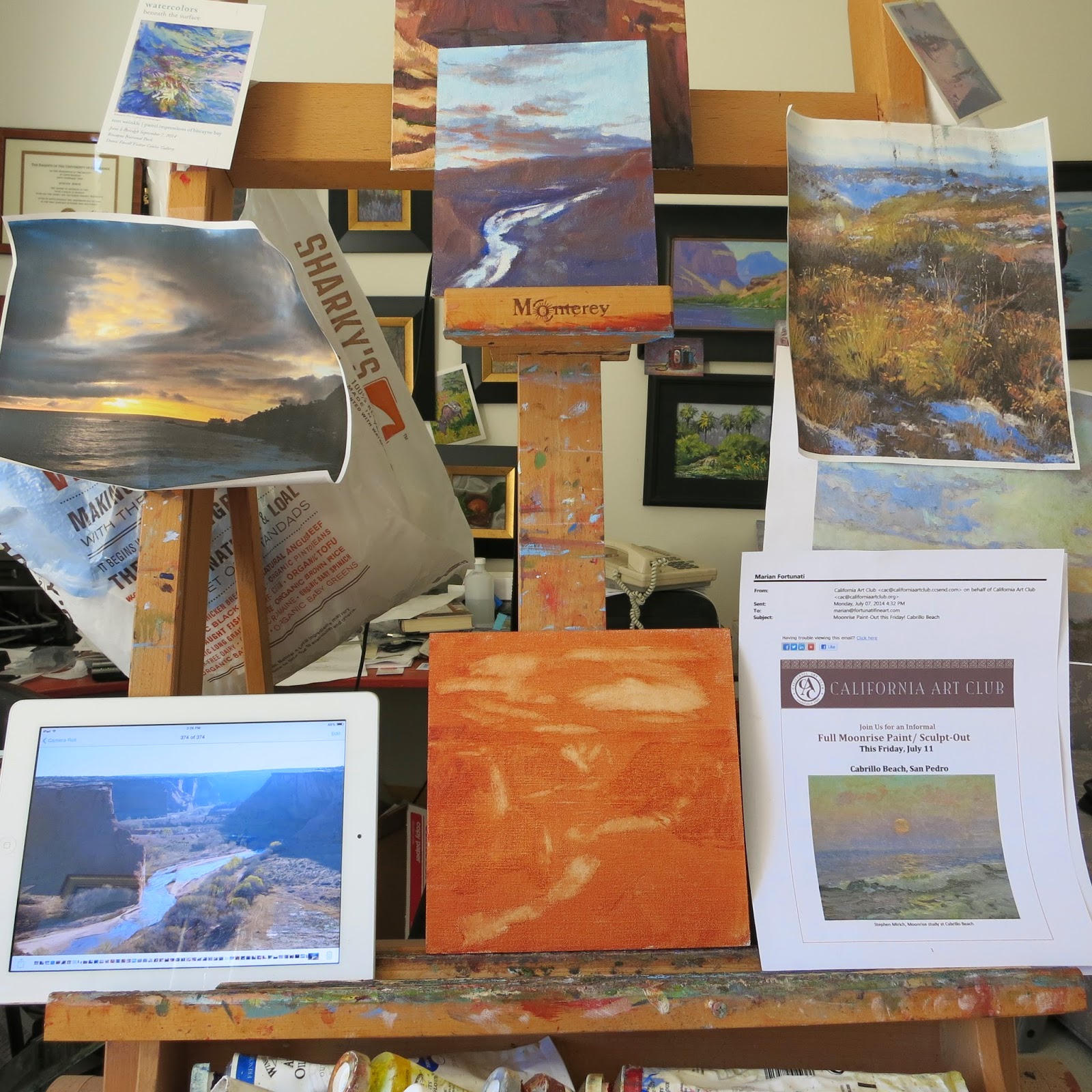
I used my original 8x6 study and several bracketed photos of the scene.  One showed the sunrise and another showed the canyon more clearly.  (Still trying to avoid the "black" foregrounds that David Gallup always tells me are indicative of using photos.)   I was also inspired by several low light sunset paintings... one by Jennifer Moses and another by Stephen Mirich.  You can see some of those inspirations (among others) beside my 3 value block in of my little painting on the easel in the photo you see on the right.  The original plein air sketch is above, the canyon image on my iPad is on the left and a photo of a moonrise by Steve Mirich is on the right.


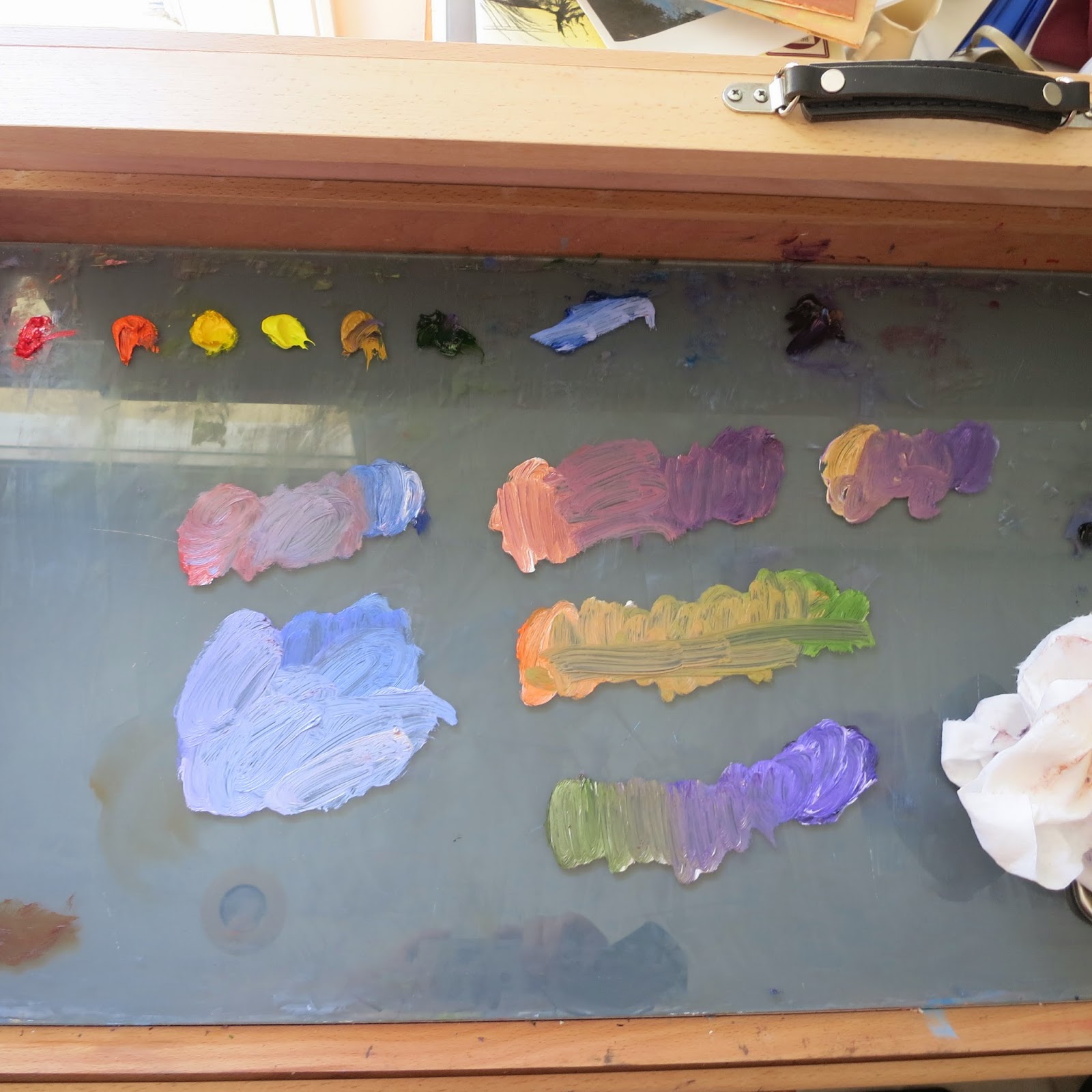
Because I was attempting to put color into what might have been a black foreground, I layed out an array of mixed secondaries.  You can see the palette in the next photo.  This is what David Gallup often demonstrates for us.  I was hoping to introduce playful color into the darks.


I layed in the color of the canyon, leaving the sunrise for later.  That would prove to be a mistake.  When I finished adding in the sky, the canyon looked way too bright.   I needed color in the darks, but I had put in too much chroma.  It just looked wrong.  I was frustrated.


After giving it a lot of thought and a bit of time, I decided to glaze over the canyon over to bring the bright colors down.... Keeping the color, but dulling them.

It was a lot better after I dulled down the canyon.  (I forgot to photograph that one... sorry.)

However, then I took it in to class and David did what he so often does with the work I bring in.  He decided he wanted to paint the scene for himself as a demo.  This is always helpful to me, of course, and the other students seem to feel it helps them as well.

I asked David why he so often does this with the work I bring in.  He told me it was because my work always had so much potential.   (I'm taking that in a positive way to indicate that I'm on the right track.)

Anyway, after watching him create his own beautiful demo, I came home and made a few changes to my own painting.... not many... but a few.  What I mainly changed were the clouds... (lightening them) .  I also bent the river a bit more as he had and built up the way the light shown down from the rising sun to hightlight spots along the river.   


I think I learned a lot doing this little version of     

"Dawn".  


I also made more changes to the painting in the last post.   I took it in to class and when David was gone, asked the class what they thought.  We all agreed it was still too dark, so I brought it home and worked on it some more, lightening it up quite a bit in the foreground.  I like it a lot better now.   Here is the latest version of     

"Blue Mesa Sunset".


It's always a great thing when you have colleagues you trust who can critique your work honestly -- telling you what they think works and what doesn't.  Then you can take what you agree with and leave what you don't.


Read Full Post


Experimenting -- It's How We Learn

One night we went up on a hillside near the Tsegi Overlook.  A beautiful sunset was our reward. 

I think we were all so surprised to see that the color of the mesa on the far side of Chinle was a brilliant cobalt blue.


For a while, now I've been experimenting with trying to get different sky and land effects when painting sunrises and sunsets.   I had been really, really pleased with this painting I'm doing for the upcoming show at Segil Gallery which I called "Blue Mesa Sunset".  


Then I took it in to my master class with David Gallup.  


One of the most useful, essential parts of every class is when we all bring in work for critique.  David always makes us share what we think about it... the parts we like best, what worked what didn't  -- what we think might be changed.  I think it has helped me to learn how to better evaluate my own work.   It also helps me see what I don't see.  -- And it helps me see in a different way.


When I started to tell David about this one,  there wasn't much I didn't like about it.  For the most part, David liked it too (especially the sky), but then he said those deadly words, "It looks like you painted it from a photograph."    David doesn't like us to use photos.  And when we do, he doesn't want us to "copy" photos... he'd much rather have us interpret -- make changes which make it a painterly painting.


Of course, once he said it, I realized that the painting did look like I painted it from a photo because my foreground was almost all black.  I have often struggled with knowing that photos don't show color in the darks, but not really knowing how to deal with it -- especially when my mind tells me it WAS dark... so the value should be dark.  Apparently I still haven't learned to deal with this.


Anyhow, I went back in to this painting when I returned home and tried to introduce color into the darks.  I'm not even sure you can see what I did with it by comparing this photo of the original painting with the one on my website.  Can you?  I think it's better, but as I look at it again right now, I'm thinking I need to make all of the values lighter.  I added color, but the values seem too dark   SIGH. 


My next post will deal with another canyon scene and a little study I did in the studio to help work out some issues before trying to paint the scene with a larger canvas.    Because of what I just did on this one, I wanted to see if I could use a plein air sketch of a sunrise in the canyon, plus a few photos and some pictures of other artists' work ... influences to help me experiment and figure out how to make my painting work better.


....And if I lighten the values on this one -- Blue Mesa Sunset -- , I'll share it again.


About a year ago I read a book called "Steal Like An Artist" by Austin Kleon.   In it he refers to all creatives and uses himself - a writer - as an example.  He writes about the importance of influences -- many influences.   A person who only has one influence is a copyist.  A person who has many influences can take those parts of each influence which most attracts him or her and combine them in order to make their own original work.  The ideas in that book really resonated with me.  Although I saw some chatter on Facebook saying that it was awful to encourage "stealing other people's work", I don't really think that those people understood what he was trying to say.  I'm reading his current book called "Show Your Work" and I am reminded of the importance of sharing what you are learning and what you know in order to "cement" your own understanding and to create yourself as an artist. 

To that end, I thought I'd share some of the hurdles I am trying to overcome as I learn to paint scenes with low light and close values.  I hope you enjoy reading about my experiments.  I'd love to hear your thoughts too.

Read Full Post


Picnic Spot - Boquet Creek (Leaving the Publisher's Invitational)

Leaving for home usually invokes a mixed feeling.  I'm always happy to return home, but usually not ready to end an adventure.  On the last day of the Publisher's Invitational, we all joined together as usual for breakfast and to make a sack lunch.  Eric Rhoads had a few announcements and thanked us all for coming.  (Of course he reminded us all of the special deals he was offering on next year's return trip and for the Plein Air Convention in the spring.  Eric is fun.  Eric is a painter.  And, of course, Eric is a salesman!  LOL)

Mary and Lynne and I all packed up, said goodbye to new friends and headed out.  Our plan was to find a great spot to paint where we hadn't been before on the way home.  We stopped at several spots and explored,  but none of them was "just right".    It was almost like Goldilocks testing all of the beds of the three bears.  We did, however, see lots of beautiful scenery.

Finally we arrived at a spot we all agreed was perfect.  It was a beautiful creek which we initially thought was part of the Ausable River.  We later found out it was called Boquet Creek.  It had shade, almost no other people and someplace private we could pee.  After we each saw to our needs, we hauled our painting gear in. (Mary pointed out where the poison ivy was... egad... all week I hadn't known what it looked like!!) 

We set up, started eating and painting and spent a lovely mid-morning painting by the stream.  When we left, we discovered we were almost to the freeway.  It was a good thing we found our perfect spot when we did or we wouldn't have been able to paint!

The drive home was uneventful.  I didn't fly out until the next afternoon, but I spent my morning blogging and looking at my photos.  I finally arrived home late at night.  Home was empty.  My husband had flown to Seattle and Tyler had gone to Oklahoma.  I was home alone.  I picked up my boys a different airports on different days later that week.

In the meantime, I had lots of art club business and painting clean up to catch up on.  I also connected with some of my new painter friends on FB.  It was a good week.

These are the paintings I did on my trip.  Some are pretty good, others -not so much.  But all will remain as good memories of a nice time.

Day 1          Heron Marsh                      From The Bridge At The Vic

Day 2          Cloud Study                        Lower St. Regis Lake

Day 3          Heaven Hills Irises          Above The Flume

Day 4          Monument Falls                Gabriel's

Day 5          Picnic Spot - Boquet Creek

Read Full Post


Topics

Archives