Never Pass Up a Great Opportunity

Everyone has their idols
An art legend in my life -- one whose work inspires me and who I would love to learn from is George Carlson. He has three great pieces in the Masters of the American West Exhibit which is currently showing at the Autry Museum. Because he was coming out for the show, the California Art Club invited him to host a "Mentor Day". This is when a notable artist critiques the work of 5 artists who sign up for the opportunity.
As soon as I heard that he was going to do this I signed up. It was an opportunity not to be missed. My friend, Chris L. Cook, also took part. It was great to share this day with him.
Uh Oh
I have only participated in a few of these Mentor Days. Not because I don't think they are great ideas, but mainly because the first time I went, I took work in which I realized afterwards that I didn't want to make changes to. I learned from listening to what he said about the other artists' work as well. I got great advice from the mentor (Jeff Horn), but I believe there is a certain time in the life of a painting when a critique is most valuable and that wasn't the point. The second time I went in, I asked the mentor (Marcia Burtt) to critique the overall body of work.... Not to give me specific things to fix on the paintings but suggestions to improve my work overall. That was most valuable.
Now that I had signed up for this Mentor day with George Carlson, I wasn't sure what to do. I didn't want to embarrass myself by taking in work which wasn't my "best", but I didn't want to take in my best work either, because I didn't want to feel bad about it or feel that I needed to make changes. So I did a compromise. I took in a piece that I have always liked, but which has never really gotten any attention from anyone else, one piece I really liked and which had gotten some nice feedback and I also took in two pieces that I was currently working on -- they were wet and unfinished. It turned out to be a good solution.
Carlson's talk
It was a two-hour session and George Carlson spent the first hour or so talking about his own history and his practices. It was perfectly fascinating.
A few quotes:
- Understand drawing to the point where you feel the other side of the head
- You don't acquire the knowledge you need unless you stay to absorb it -Make a statement
- When you are really following your bliss, doors open
- There are 4 criteria in making great art: Intelligence, Sympathy, Taste, Skill
- Understand your intentions - Why are you doing this?
Carlson isn't a plein air painter. When he goes outside, he does it to gather information for his paintings. He finds landscapes and places that speak to him... They are his "nirvana"
He takes notes when he's out in the landscape. He draws and makes notes about composition
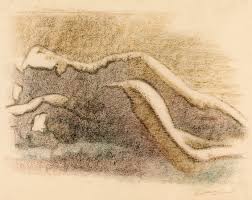
He shared some of his drawings from an exhibition book which he donated to the CAC
Sometimes he thinks of the forms of the landscape in the areas around him as might be seen in the form of a woman's body


He loves making color charts -- on his horizontal and vertical matrices are color and value
He takes his color charts of color and value out with him and uses those to annotate his drawing.
He calls this informed drawing..... Not a pretty drawing but one which includes notes about color, value and intensity
He meditates and lets the environment set in
He loves triads and also split complements
When in the studio he uses his drawings as well as photos and spends time doing a lot of planning before he puts down a brush stroke
He designs things -- he borrows and either subtracts or adds things to make a good design
He plans what is over and what is under each layer
He said that if you get your values right -- even if the colors are wrong, it will still read correctly
The intensity of the color needs to be in the right value zone
Do exercises to nail the colors into the right values
Creativity is partly curiosity
You need to do your own thing - You need to find out what makes you "you"
If you get all of the things right then the feeling will come through
Every expression of an artist should be an expression of the adventure of his soul
He likes to drag paint across the top of other dried paint
Sometimes he sands a painting down to get rid of the "white caps" (the ridges left by a brush)
A painting should work when you stand back but you hope for engagement in surfaces upon close inspection
Sometimes he turns his paintings upside down to evaluate them
The Critique
When George Carlson looked at my paintings he focused mostly on the cactus painting you see above which was one of my WIPs. He liked it. He said there were some accents that were too repetitive. He thought there should be one or two strokes with lighter yellow and more texture. One area of dark should be a lighter dark. I tried to use his critique to finish this painting. Now it will sit for a while (maybe upside down) while I reevaluate it over time.
He also looked at my painting called Blue and Gold. He thought I should not have so many regular fence posts. He suggested bringing some of the mountain color into the trees. He said everything you put in a painting is a relationship
The last painting he critiqued which was another WIP was "too spotty" He reminded me of the importance of massing and remembering where the light source is. I will work on that.
It was a great day and I felt very fortunate to have had the benefit of his thoughts and lessons.

