Blog


Crystal Clear - Day 3 Matt Smith Workshop

Will I ever "GET" it?
As I have known (and apparently not been able to embed into my brain) since 2007 when I went to Italy to join Scott Burdick's plein air workshop in Cinque Terre, that getting the values of a painting "just right" is THE most important work you can do in any painting.   I keep thinking I'm making progress...  actually I AM making progress....  but getting the relative values right away still eludes me at times.  On our last day following Matt's demo when we had a chance to paint and receive advice, once again, I let "what I know" tell me a value rather than judging the sunlit and shade values as relative lights and darks as I should have.  I continually fall into painting the local color that I "know" rather than what I should be seeing.  Of course, I believe, painting in plein air helps me with this.. when I use photos, I often fall back into old bad habits.


After being reminded once again, I went over my block in and made the little painting work a bit better.

"Crystal Clear"


Matt's final demo

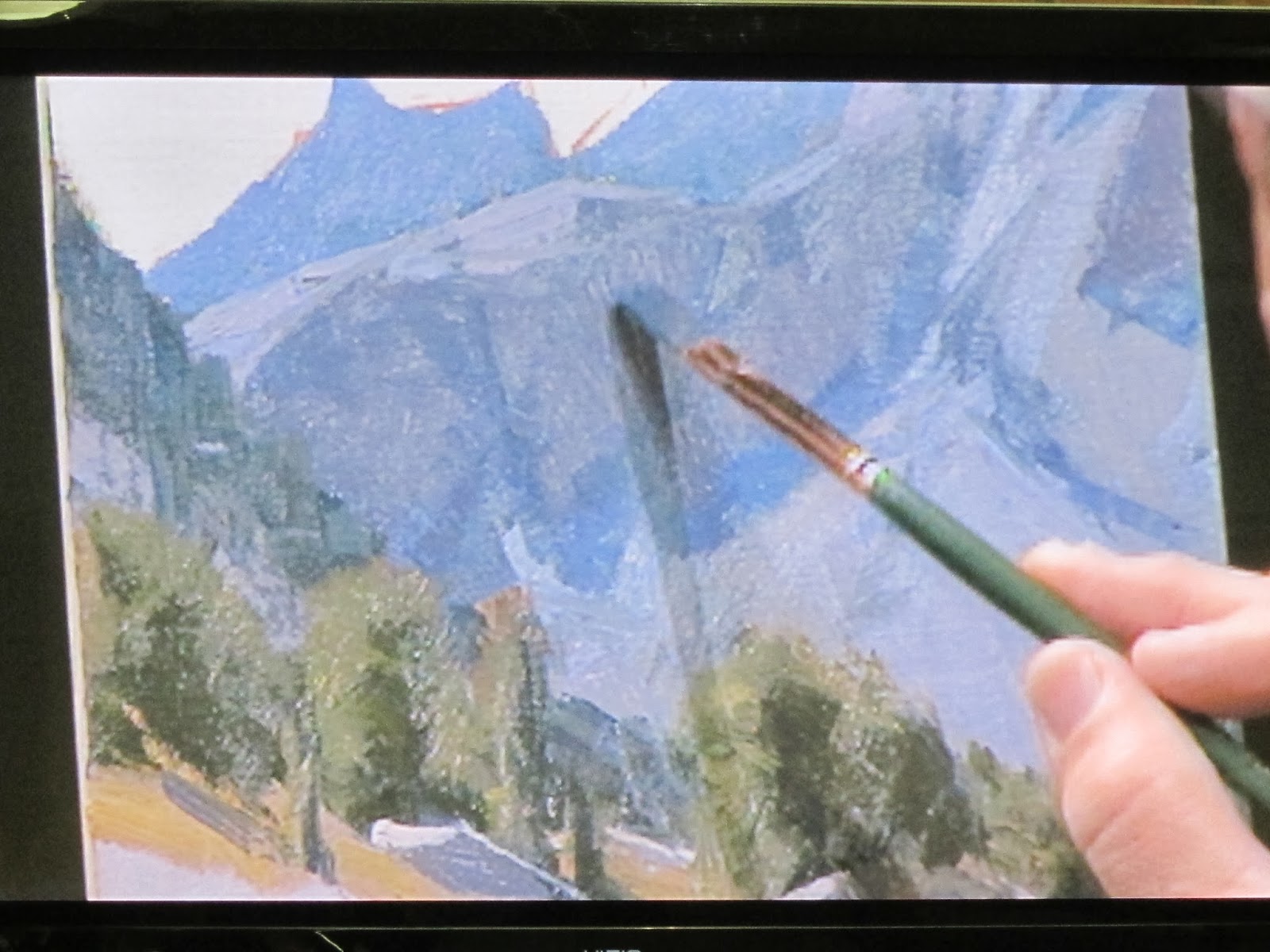
On the last day of our workshop, we had a special treat because Glen and Karen Winters were there from the California Art Club with their cameras.  They were able to project what Matt was doing onto a large screen which made it much easier for all of us to see.

Once again he used a small photo of a scene as his stepping off point.  It was actually a similar scene to one he has in the current Masters Of The American West show at the Autry right now.  Here are some

things Matt talked about as he painted his wonderful demo:
  • Ask yourself - "What do you want the viewer to look at?"  eg.  the mountains or the stream
  • Always establish the horizon line so you can relate vanishing points
  • Establish a series of major shapes first
  • Shadows define the drawing
  • Ask yourself how you can use patterns to move the viewer's eye around the painting
  • Get in there and paint it like you mean it
  • Don't be timid
  • It's okay to start a little dark
  • When you're out there everything out there has one goal.....   (LOL.. to ruin your day).. gnats, heat, cold, wind, rain, snow, etc.
  • During the first stage at least 50% of your paintings will look clumsy
  • If you give your viewer a chance to leave your painting, they'll take it
  • The last 10% of the painting often takes 90% of the time... you're fine tuning
  • Use a mirror to help you re-see your work   ... helps you find errors and problems
  • Work your edges
  • Create planes that add depth to a 2 dimensional panel
  • All abstraction can be found in the natural world
  • Don't put too much finish into your work too quickly    It's all about doing then undoing several times
  • Always emphasize warm shadows and caste shadows
  • The fundamentals are totally important
  • Tries to train himself to see in terms of form not line
  • Use textural passages... determine when and why... they don't make sense if you have thick paint everywhere
  • Light defines texture.. thickest paint is usually around the lightest light or the focal point
  • The foreground is one of the easiest parts of a painting to overwork... You have to define what is there but keep it simple enough that the viewer can move beyond it

Master Artists to influence our work

Another nice treat during the 3 day workshop was hearing about all of the wonderful artists and their work which Matt admires and who he studies to gain insights...   some mentioned were:

  • Victor Higgins, Edgar Payne, Scott Burdick, William Herburt Dunton, Len Chemiel, George Carlson, Bill Anton, Carl Rungus, Eugene Bracht, Zoladz Stanislaw, Scott Christianson, Ralph Mayers (Guide To Artists Materials and Techniques), Sir Alfred Munnings, James Elwood Reynolds, Frederick Judd Waugh, William Frederic Ritschel, Alan Been, Frank Tenney Johnson were those I managed to write down. 
  • When pressed about why there were no women on his lists he named some but said women have families first in their minds... artists are more selfish....     The women he named were Laura Robb, Rose Franzin, Susan Lyon, Jean LeGassick
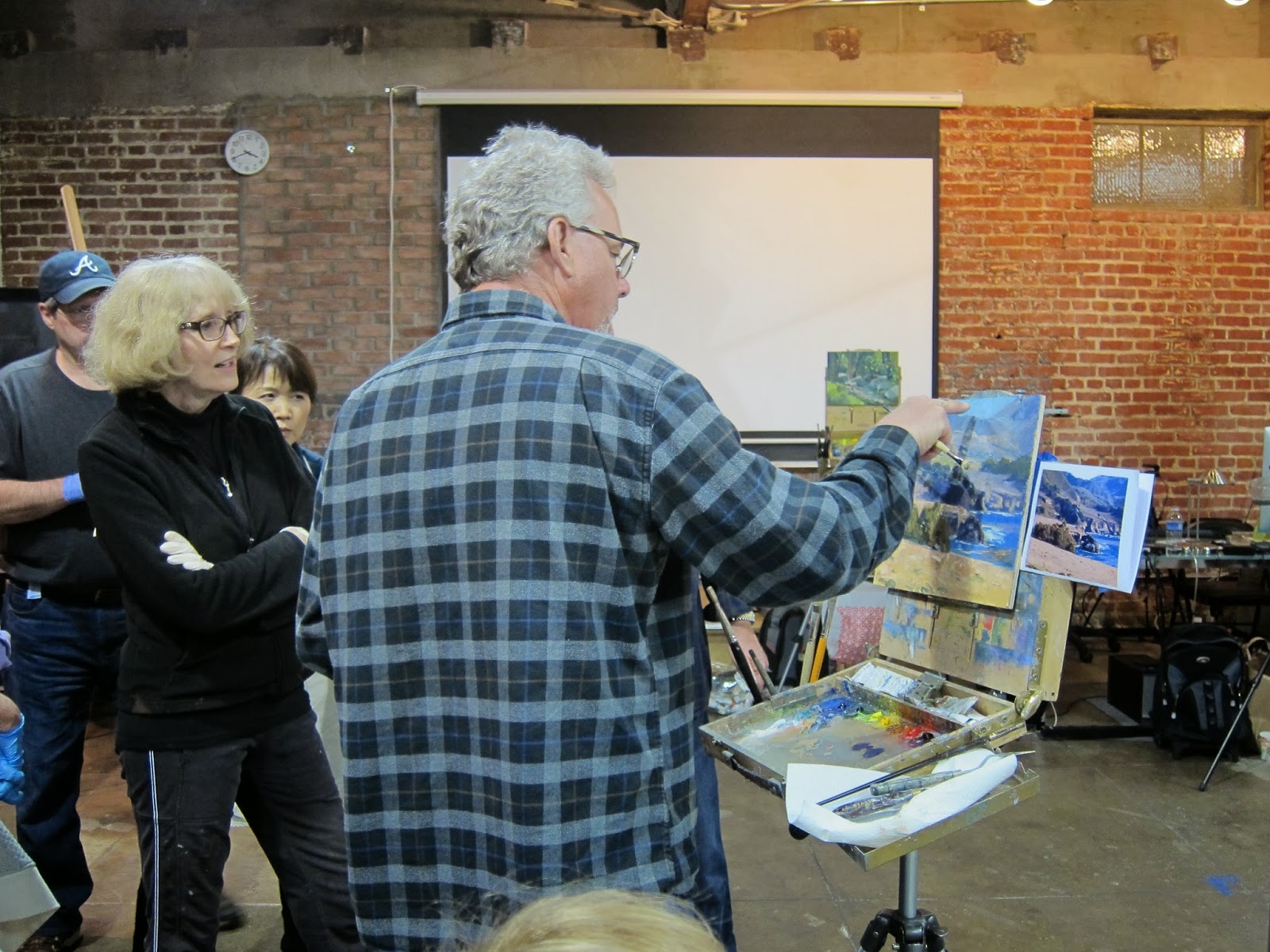
Matt says that using a large variety of artists as inspiration is wonderful but using only one is derivative and copying.

This reminds me a lot of a book I read recently called "Steal Like An Artist: 10 Things Nobody Told You About Being Creative" by Austin Kleon.   I highly recommend it for all creative types.

All in all it was a fabulous workshop... well worth my time.   We all learned from the lectures the demos and the critiques.


Read Full Post


More From The Matt Smith Workshop

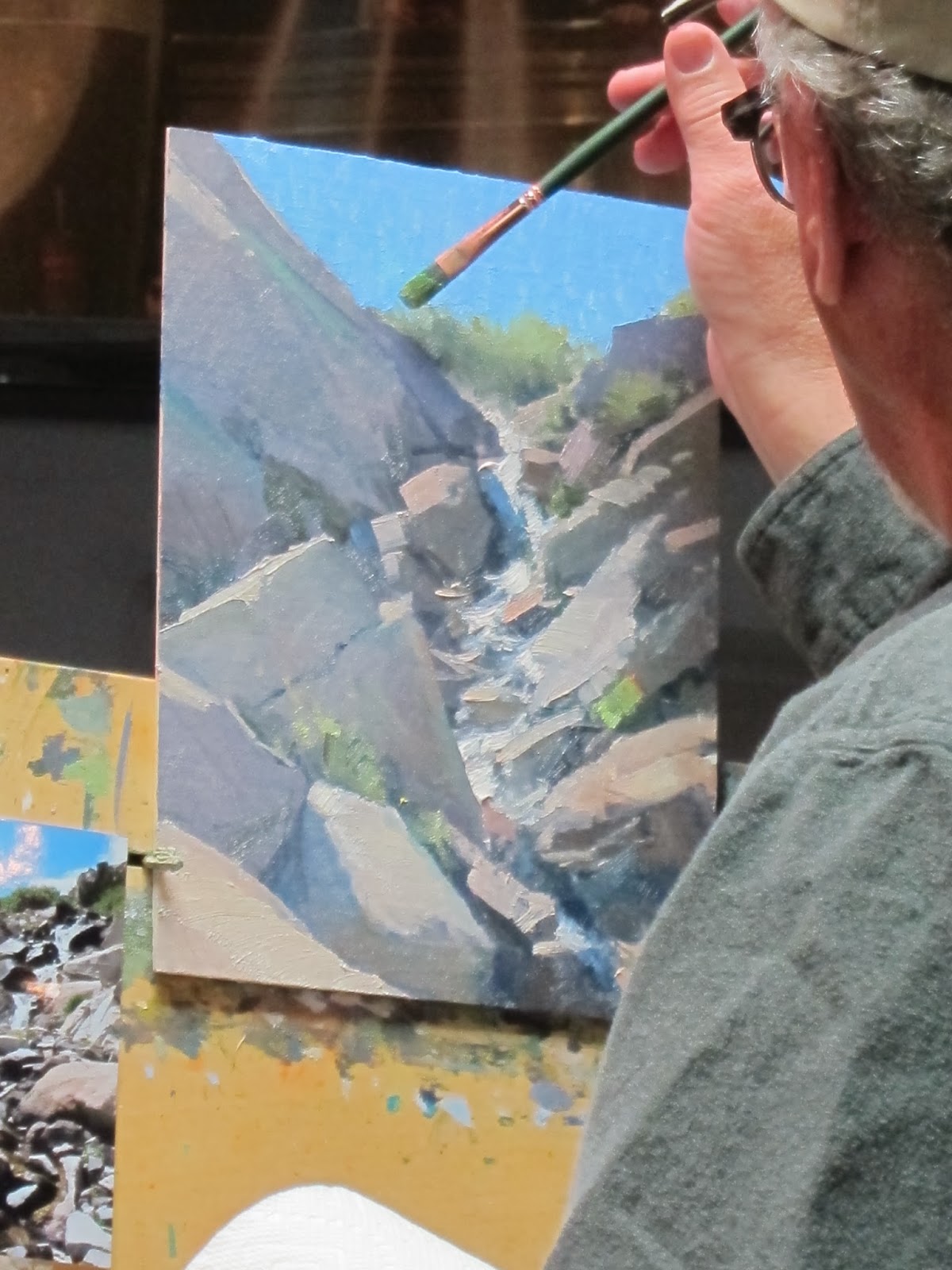
After a morning filled with inspiration and stories (see my last blog post) we broke for lunch.  When we all returned, we were enthralled to watch Matt put action to all of his words.  He demoed using a small 4x6 photo reference of a waterfall cascading down a jumble of rocks.  He reminded us that a real artist doesn't copy...   the photo is used as a springboard for the "conversation" with the paint.  In the studio he will use a series of photos and studies and the springboard for studio creations.  He warns us not to be "a slave" to the subject.  We are not painting photographs.  We are creating paintings.

Matt talked about surface quality -- pushing and pulling the paint.  Surface quality of the paint is what we all enjoy seeing up close.  Typically he will use a different brush for each color/value shift, but during the demo he continually emphasized the importance of keeping a clean palette and a clean brush.  He enjoys pushing paint.   He pushes his brush into the paint to load it up and twists as he lays it on lightly for highlights and "calligraphy".   He turns his brush all of the time when he paints.  Sometimes he "scribbles" as he is looking for a design.

  • He softened the edges of cascading water to give the effect of motion.  
  • He asked us to continually ask ourselves, "Does it look right to you?"
  • He said that the only deep dark sky is when we are looking straight up toward the zenith.
  • A photo lies every way it can.
  • You can turn an edge with color.
  • Where 2 values come close together, make them one.
  • Your painting is either about value or it's about color.
  • When Matt does the sky he creates a "velour effect" to give the sky some modulation...  Not one big block of color.
  • A dynamic sense of design has lost and found, light and shadow and lots of interesting brushwork

For his waterfall painting that is in the Autry Masters show right now he used several studies...  one horizontal small, one vertical close in, and one backed out.

On DAY TWO we all painted as Matt came around to make suggestions, show us how and give us tips and more encouragement.  I painted the first painting above which I called "Desert Wash" from a photo Matt had in his files for us to use.  Matt gave me quite a bit of help on this one reminding me that we need to add modifiers to the blue, not to add blue into the modifiers...   sigh.  I have to admit the beautiful color he came up with on the far hills just set it all off beautifully.

Marble Canyon Reflections   9x12 O/C

The second painting I did was done from one of my photos from my Grand Canyon trip.  I once again had difficulties... I tried to paint everything blue.....   Obviously I missed the whole point.  So I began again and tried to get the values right... sunlight shadow... warmer cooler.   Painting is really so much harder than most people realize.   I finally ended up with the second painting of the day, "Marble Canyon Reflections".

On my next blog post I'll describe the last day during which we watched a demo (fabulous) and painted another under Matt's supervision.)

One of these days if I practice often enough, I may "get it".  Until then... at least I'm enjoying the journey.  

Read Full Post


Crescendo --- My Painting and A WONDERFUL MATT SMITH WORKSHOP


Origin of my work, Crescendo
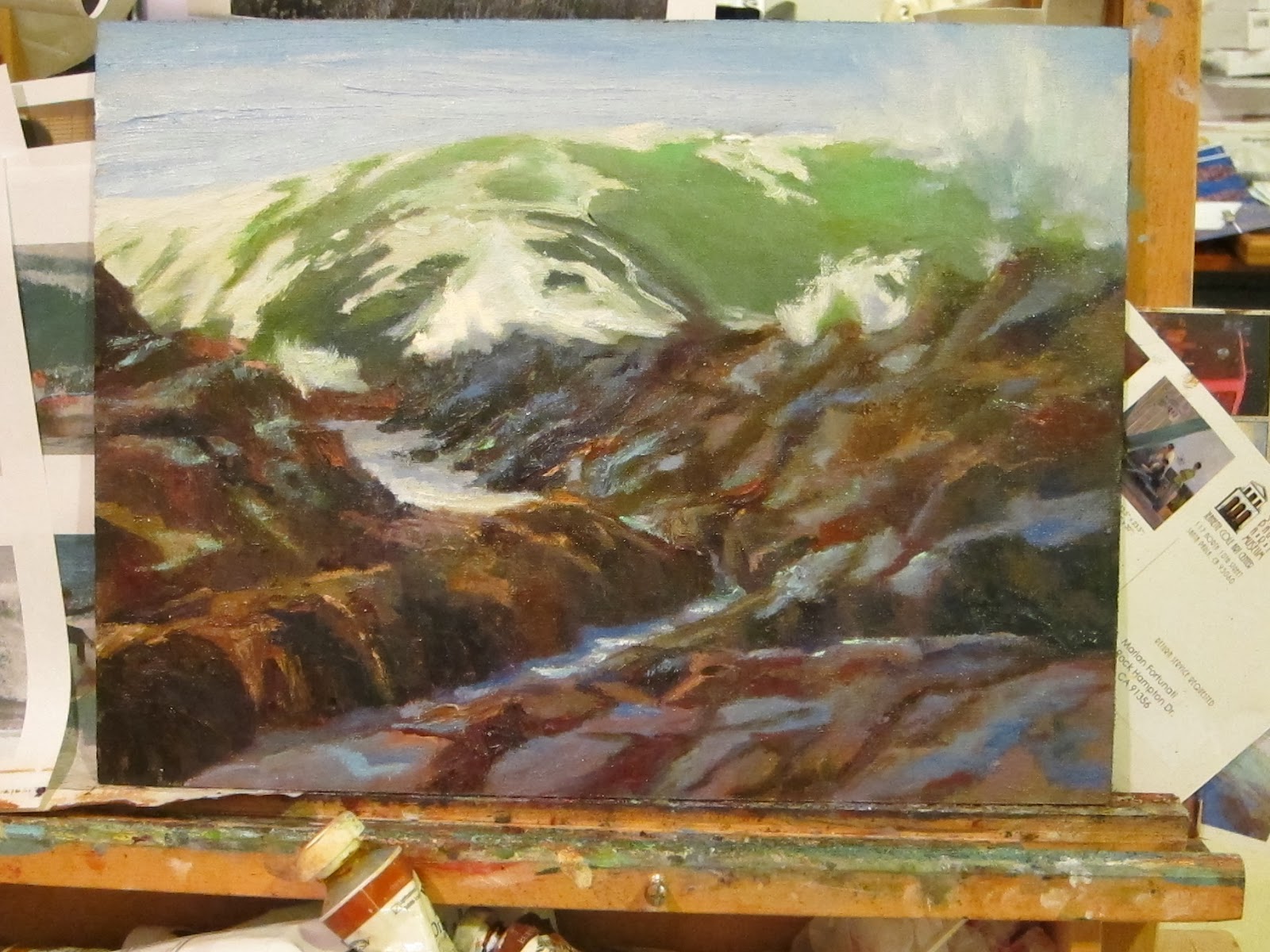
As many of you know, I visit Leo Carrillo State Beach to paint outdoors often.  Sometimes I try to paint Leo scenes in the studio.   I always take a lot of photos and this one really caught my eye.  It was taken the same day I painted the plein air piece in the last blog post. 

"Exhilaration"

The wave was just building up and it seemed to be very special so I wanted to paint it.   I started with the building wave and then painted the rocks later.  I was really happy with the water and the waves, but less satisfied with the rocks.

Tall Ship Adventure

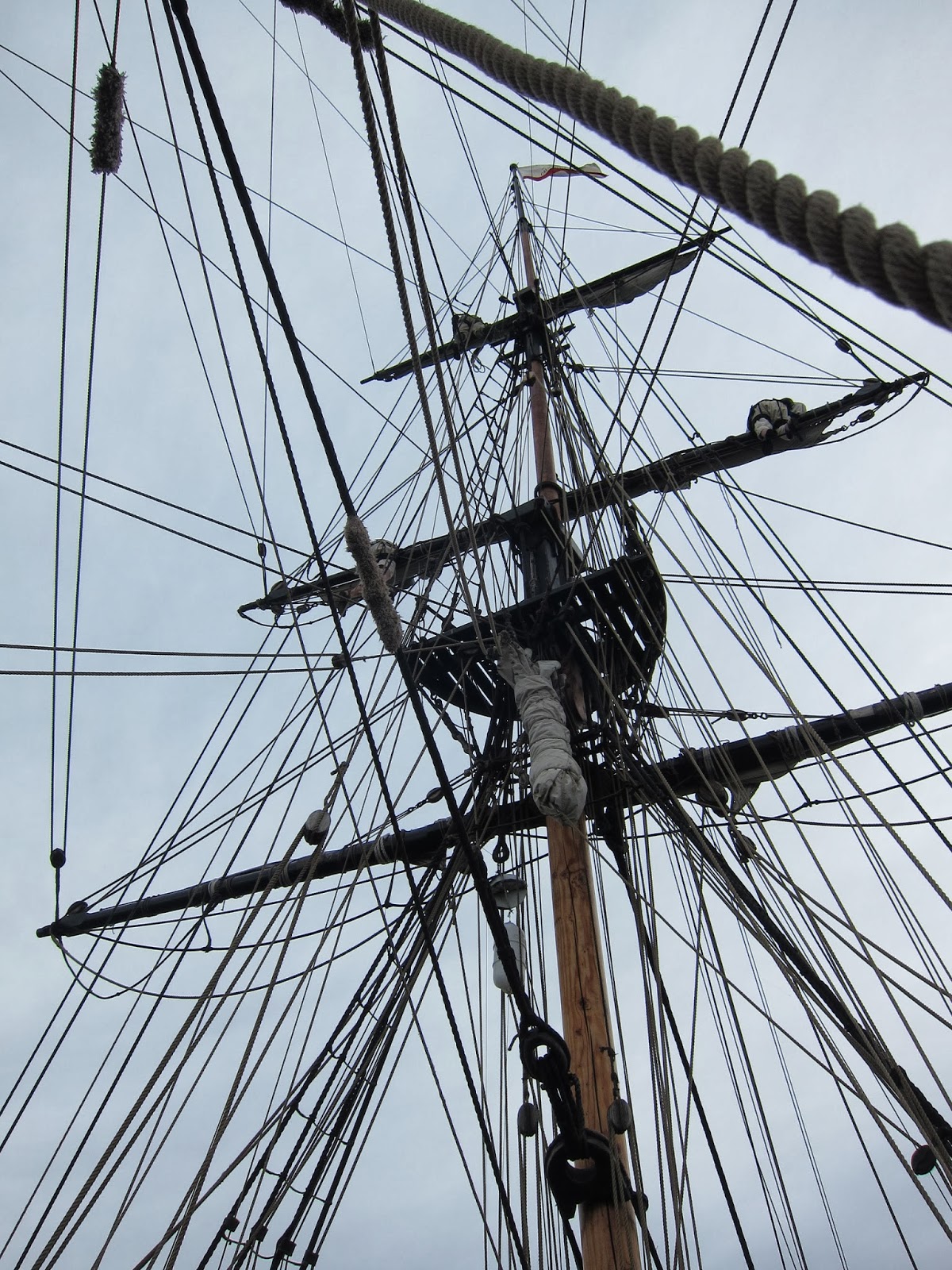
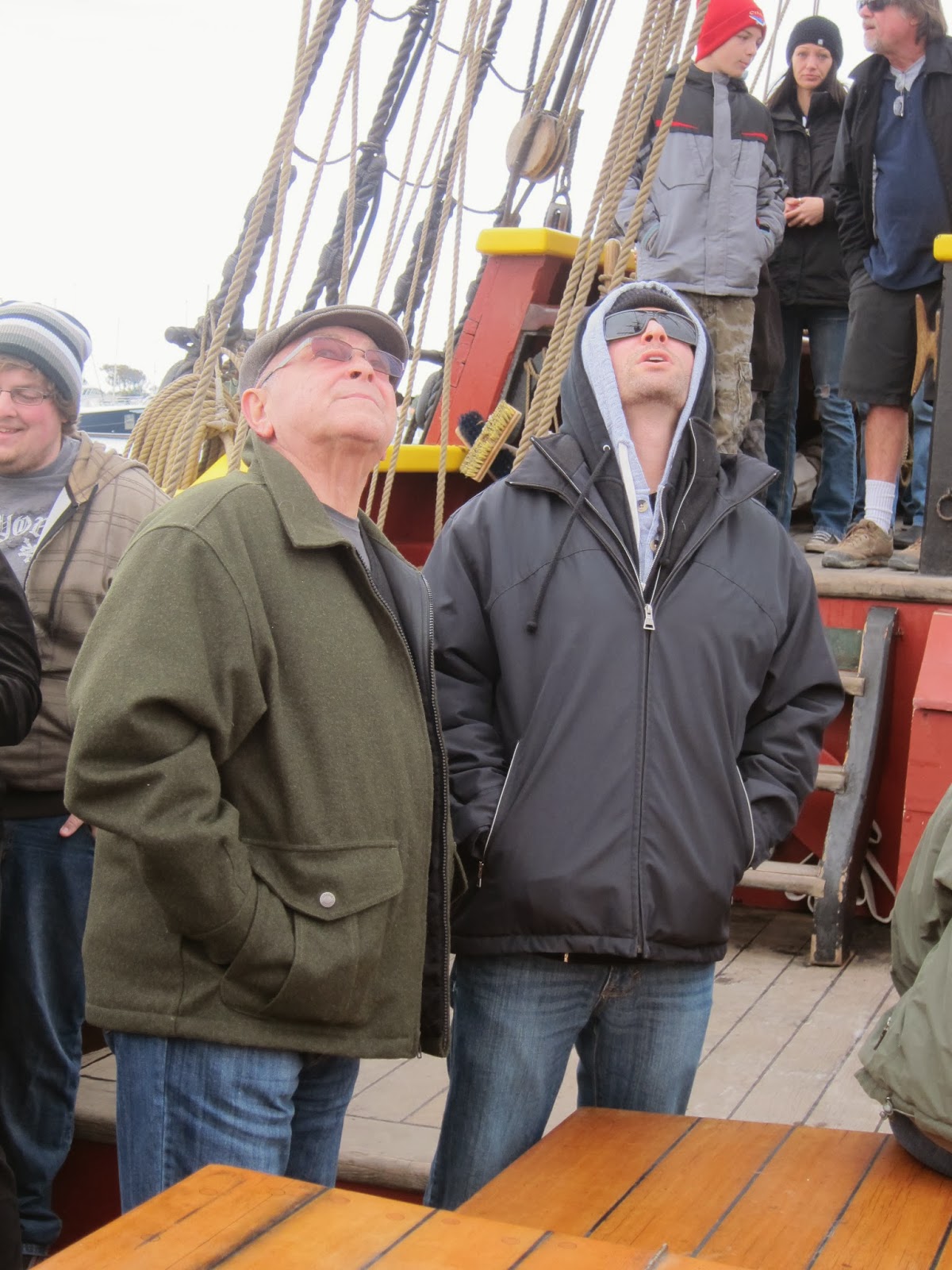
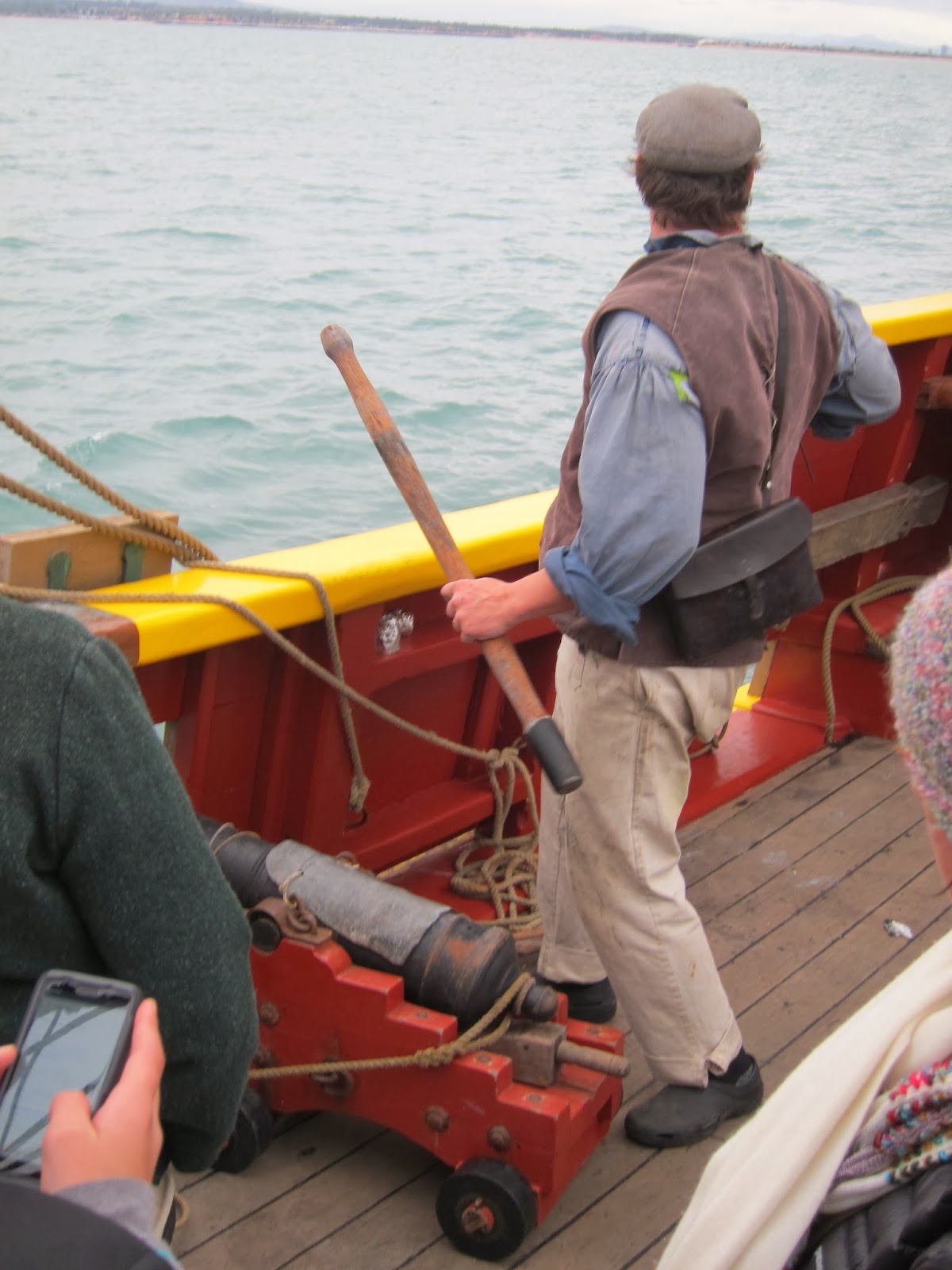
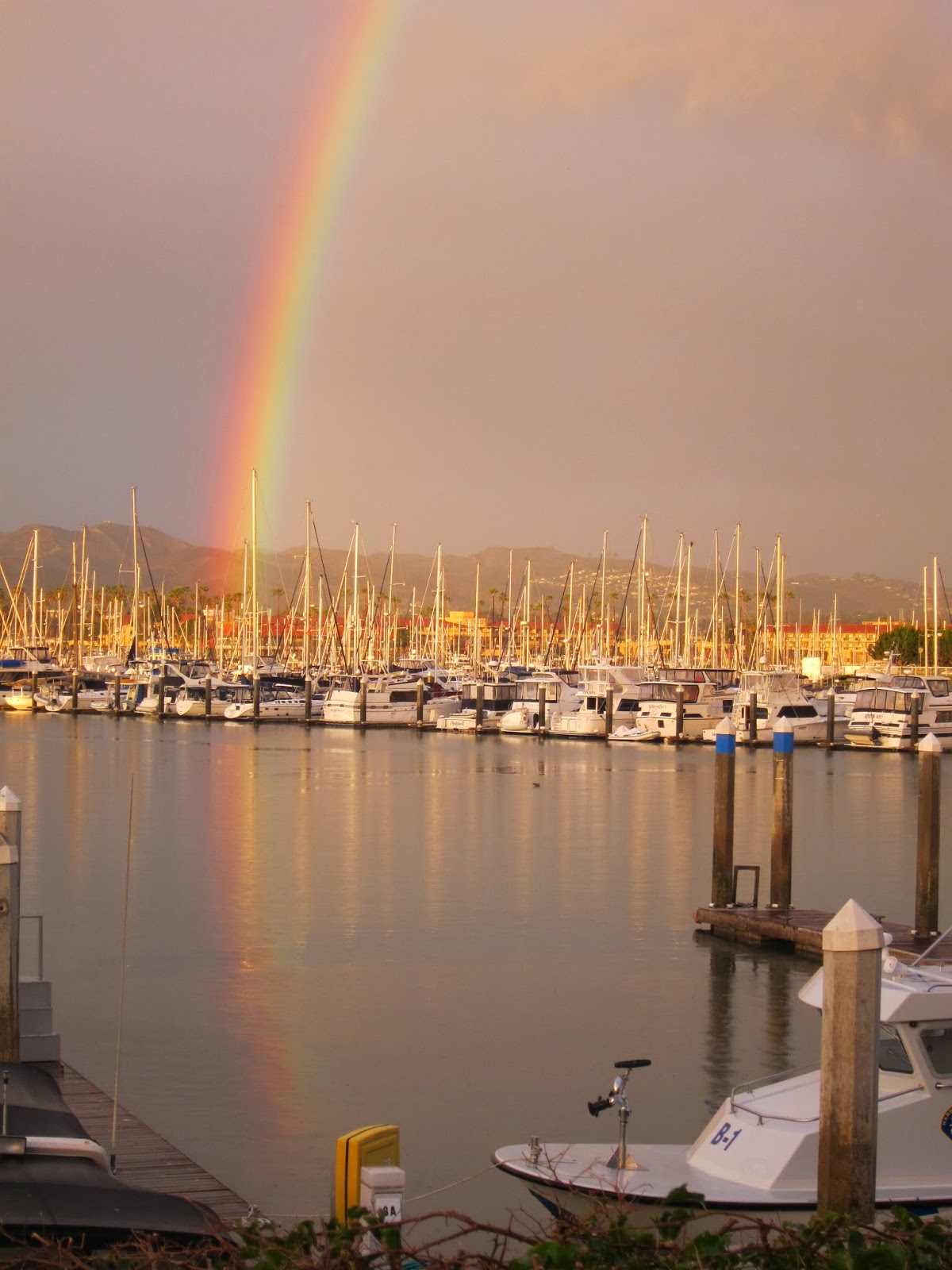
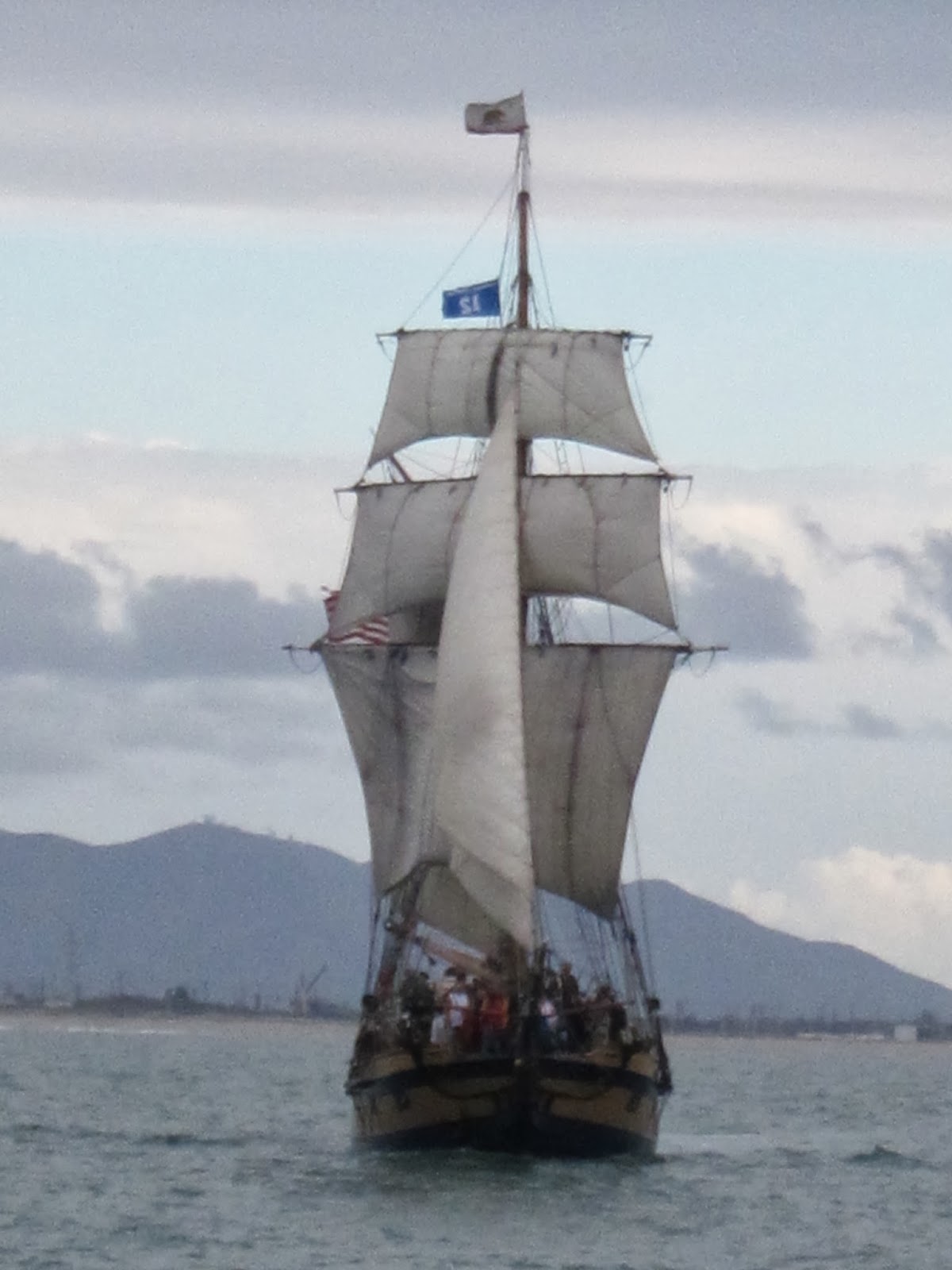
However, I didn't have time to figure out what was wrong with the painting.   Over the weekend my husband returned from Italy and we went up to a show opening in Ventura to meet our daughter and her family.  Then on Sunday we went back to Ventura to meet our son and his wife to board one of the tall ships which were in the harbor.  The tall ships were going to have a mock battle.  We all had a great time -- even though it rained during the last part of the battle.  The good news was that after we came ashore and before we went to dinner we were greeted with a beautiful double rainbow... you can't see the second one in this photo, but you could see the whole arch... It was gorgeous.


Matt Smith Workshop


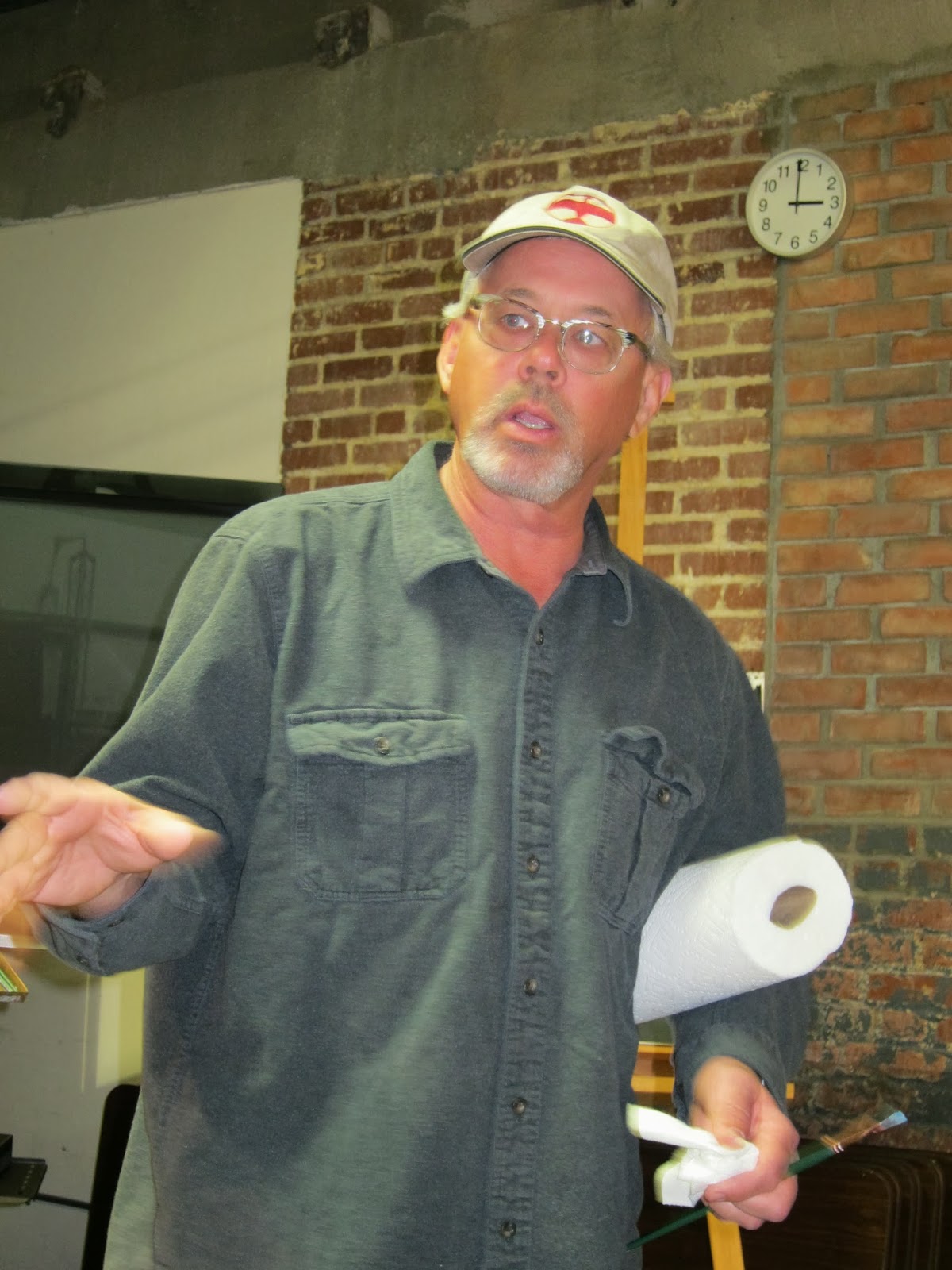
The California Art Club organized a workshop led by talented artist, Matt Smith.  As soon as I heard about it, I jumped on the opportunity.  There were 16 people in the group and I knew 4 of them.    We all felt it was one of the best workshops we could have taken.

Here are my some of my notes from the first day:

  • Always decide what the subject is about before you design a painting
  • Drawing, value, design and color -- most important elements
  • The most important understanding is how natural light works... It is wildly different outside than it is in the studio
  • Photos make our life easy and at the same time they are a nightmare
  • Matt works in the field most often but also feels that studio work is important
  • Warm light sources do NOT have warm shadows
  • References should be the source of conversations  -- they shouldn't "tell" you what and how to paint.
  • Every filter between you and your subject alters your work
  • Color equals:   hue -- value -- intensity --  temperature
  • Even though color is the most emotional element if the following   -drawing, value, design and color , color is the only one that you can do without
  • Drawing
    • There is a big difference between line and form  -- line is 2 dimensional -- proportional     form is 3 dimensional -- perspective
  • You must always be fighting what you "know" with what you see
  • Warm light source - cool shadows
  • Put in cool colors for shadows such as blue and modify them ---  warm up from the blues as needed -- never the other way around
  • There are three light sources outdoors -- direct light, reflected light, reflected blue skylight (flat surfaces looking up)
  • There should be a separation between form shadows and caste shadows
  • Sneak up to subtleties
  • Highlights on clouds in the distance get warmer as they get farther away  -- cloud bodies cool as they recede
  • Clouds that are higher above you are rounder than they are farther away
  • As per Carlson, there are 4 basic values in a landscape:  sky (lightest), ground, incline and upright (darkest)
  • Always paint large to small, dark to light, thin to thick, cool to warm
  • Design
    • Motif = subject   How do you resolve everything around it to resolve the negative shapes
    • Try to keep masses within relationships close
    • STRONG, SIMPLE design
    • You should always be able to describe the painting verbally
    • Format:  vertical, horizontal, square, etc.
    • Contrast
    • 2 D shapes
    • 3 D shapes
    • Balance -- left to right, foreground to background, linear movement into the painting
    • The artist MUST know where the horizon line is in his/her painting.  Vanishing points are established from the horizon
    • The vanishing point could be a focal point ... you use vanishing lines to flatten your foreground and create the illusion of depth
    • Texture
    • Edges
  • Color
    • Hue, value, intensity, temperature
    • Light direction, light intensity and color all depend upon time of day... (value contrasts are closer when the sun is lower)
    • You can turn form with color like Sorrolla did

The first morning was basically a lecture... not a dull boring one, but one that was full of information, clear concise and well organized and rich with humor and personal examples.  Additionally his information and examples were peppered with great references to the work of historical artists and contemporary artists that Matt felt we should be using to educate ourselves further.   He studies the work of many artists to further his own growth.  He encouraged us all to "steal".   He said if we steal from only one artist then our work will be derivative and just copying.   If we steal from 50 artists then we are learning from the best and will use what has meaning for us and for our own unique work.  All of us in this workshop felt very lucky to be there learning from a world class artist and an outstanding teacher. 

To bring some relevance to why I started with a painting I didn't even do in the workshop, I will say that listening to Matt talk, I was reminded many times of the admonishments of teachers I've had in the past...  During my ten-day Colorado River trip through the Grand Canyon with Kevin Macpherson he was always talking about sunlight and shadow and warm and cool.  Of course David Gallup, my mentor, peppers all of his information with examples of other great artists' work.   But I have to say that as I listened to Matt, it occurred to me why I wasn't happy with the painting.   The areas that were clearly in sunlight were not lit up.   I was painting what I "knew" not what I saw.  SIGH...  Why do we continue to make the same mistakes over and over.

Anyway, I went home and over several days have altered the painting called

"Crescendo"


to light up the sunlit areas a bit more.  I will REALLY work to make the sunlit areas clearly sunlit using value and temperature in all of my future work....  I am sure, however, that one lesson will take lots and lots of practice to become habitual. 

I'll write more about the workshop which lasted three days in subsequent posts.

Read Full Post


Topics

Archives